

Partner:

Supported:



Dear Readers,
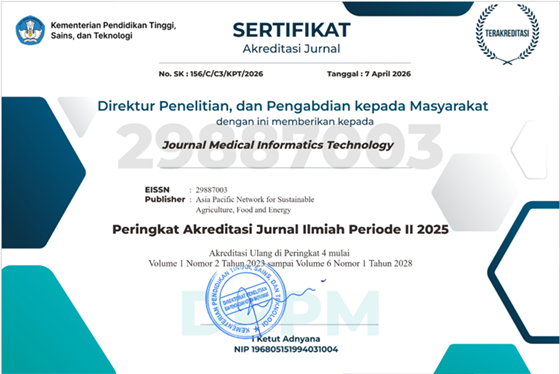
We are delighted to share the annual report on the citation performance of Journal Medical Informatics Technology (MEDINFTech). In recent years, MEDINFTech has consistently maintained a reputation for being a leading institution in the field of Biomedical Informatics. The annual citation metrics compiled by Scopus show that the scholarly community has recognized our commitment to publishing exceptional and ground-breaking research.
This report highlights the achievement of MEDINFTech in receiving a significant amount of citations in the Scopus database since 2023. The annual citation count serves as evidence of the research published in MEDINFTech being both relevant and impactful, while also highlighting the journal's increasing importance in the academic world.
As we contemplate this accomplishment, we express our sincere appreciation to our outstanding authors, devoted reviewers, and industrious editorial team for their steadfast support and dedication to achieving excellence. Through the combined efforts of its members, MEDINFTech maintains its success as a platform for sharing advanced research and promoting academic discussions.
In the future, we are committed to maintaining the highest standards of academic publishing and to increasing the visibility and influence of MEDINFTech worldwide. Year after year, we continue to demonstrate our commitment to progressing knowledge and promoting innovation in the areas of Biomedical Informatics.
[1] S. Nuarini, “Optimization of Breast Cancer Prediction using Optimaze Parameter on Machine Learning,” Journal Medical Informatics Technology, pp. 25–30, Mar. 2023, doi: 10.37034/medinftech.v1i1.5.
[a] Mamta, S. V. Patil, M. Alate, and A. Pagrotra, “Hierarchical Deep Reinforcement Learning with Neural Turing Machines for Treatment Path Optimization,” 2023 International Conference on Artificial Intelligence for Innovations in Healthcare Industries (ICAIIHI), pp. 1–6, Dec. 2023, doi: 10.1109/icaiihi57871.2023.10489355.
[b] V. K. Suri, A. Yacha, C. B, L. Patchava, K. L. Raju, and K. K. R. Penubaka, “A Robust Machine Learning Framework for Breast Cancer Prediction: Integrating Hybrid Feature Selection and Ensemble Learning,” 2025 5th International Conference on Expert Clouds and Applications (ICOECA), pp. 910–915, Mar. 2025, doi: 10.1109/icoeca66273.2025.00159.
[2] D. S. Wita, “Image Segmentation of Normal Pap Smear Thinprep using U-Net with Mobilenetv2 Encoder,” Journal Medical Informatics Technology, pp. 31–35, Jun. 2023, doi: 10.37034/medinftech.v1i2.6.
[a] J. Tang, T. Zhang, Z. Gong, and X. Huang, “High Precision Cervical Precancerous Lesion Classification Method Based on ConvNeXt,” Bioengineering, vol. 10, no. 12, p. 1424, Dec. 2023, doi: 10.3390/bioengineering10121424.
[b] A. Desiani et al., “Simple Data Augmentation and U-Net CNN for Neclui Binary Segmentation on Pap Smear Images,” Journal of Electronics, Electromedical Engineering, and Medical Informatics, vol. 6, no. 3, pp. 264–275, Jul. 2024, doi: 10.35882/jeeemi.v6i3.442.
[c] Ed., “MAAU-NET: A Hybrid U-Net with MobileNetV2, ASPP, and Attention for Landslide Segmentation,” International Journal of Intelligent Engineering and Systems, vol. 18, no. 8, pp. 536–546, Sep. 2025, doi: 10.22266/ijies2025.0930.33.
[d] B. Z. Wubineh, K. Halawa, and A. Rusiecki, “Novel Deep Network Architecture for Multicell Segmentation of Pap Smear Images,” Procedia Computer Science, vol. 278, pp. 1128–1136, 2026, doi: 10.1016/j.procs.2026.03.092.
[3] C. Nugraha and S. Hadianti, “Glaucoma Detection in Fundus Eye Images using Convolutional Neural Network Method with Visual Geometric Group 16 and Residual Network 50 Architecture,” Journal Medical Informatics Technology, pp. 36–41, Jun. 2023, doi: 10.37034/medinftech.v1i2.7.
[a] S. Anandhi and K. Anand, “Enhancing Glaucoma Diagnosis with a Novel Optic Disk Localization and Classification Framework Based on U-Net and ResNet-50,” 2024 International Conference on Innovative Computing, Intelligent Communication and Smart Electrical Systems (ICSES), pp. 1–7, Dec. 2024, doi: 10.1109/icses63760.2024.10910444.
[b] A. Kaur, “A Deep Learning Approach to Glaucoma: CNN Role in Early Detection,” 2024 Second International Conference Computational and Characterization Techniques in Engineering & Sciences (IC3TES), pp. 1–5, Nov. 2024, doi: 10.1109/ic3tes62412.2024.10877557.
[4] W. Bismi and J. Na`am, “Classification of Myopia Levels using Deep Learning Methods on Fundus Image,” Journal Medical Informatics Technology, pp. 42–48, Jun. 2023, doi: 10.37034/medinftech.v1i2.8.
[a] N. Rizzieri, L. Dall’Asta, and M. Ozoliņš, “An Automated Diagnosis of Myopia from an Optic Disc Image Using YOLOv11: A Feasible Approach for Non-Expert ECPs in Computer Vision,” Life, vol. 15, no. 10, p. 1495, Sep. 2025, doi: 10.3390/life15101495.
[b] N. Rizzieri, L. Dall’Asta, and M. Ozoliņš, “Myopia Detection from Eye Fundus Images: New Screening Method Based on You Only Look Once Version 8,” Applied Sciences, vol. 14, no. 24, p. 11926, Dec. 2024, doi: 10.3390/app142411926.
[5] Daniati Uki Eka Saputri, Nurul Khasanah, F. Aziz, and Taopik Hidayat, “Enhancing Skin Cancer Classification Using Optimized InceptionV3 Model,” Journal Medical Informatics Technology, pp. 65–69, Sep. 2023, doi: 10.37034/medinftech.v1i3.14.
[a] P. Sharma, G. Jain, P. D. K. Thakkar, S. Jain, A. K. Phulre, and S. Joshi, “Multi-Class Classification and Detection of Brain Tumor ROI: Yolov9-CNN,” 2024 International Conference on Intelligent Algorithms for Computational Intelligence Systems (IACIS), pp. 1–10, Aug. 2024, doi: 10.1109/iacis61494.2024.10721653.
[b] Y. Jusman et al., “Evaluation of Image Enhancement Techniques for Improving Skin Cancer Image Processing,” 2024 International Conference on Information Technology and Computing (ICITCOM), pp. 82–87, Aug. 2024, doi: 10.1109/icitcom62788.2024.10762559.
[c] O. Touameur, F. Harrag, and M. Deriche, “A Hybrid Convolutional Neural Network and Graph Convolutional Networks framework for Effective Skin Spot Classification,” 2025 IEEE 22nd International Multi-Conference on Systems, Signals & Devices (SSD), pp. 725–730, Feb. 2025, doi: 10.1109/ssd64182.2025.10990013.
[d] N. Khasanah, T. Hidayat, E. Firasari, L. Kurniawati, and E. H. Hermaliani, “Deep Learning Architecture Optimization for Skin Cancer Image Classification on Multi-Source Dataset,” International Journal of Robotics and Control Systems, vol. 6, no. 1, pp. 507–527, Feb. 2026, doi: 10.31763/ijrcs.v6i1.2424.
[6] S. Hadianti, “Optimization of The Machine Learning Approach using Optuna in Heart Disease Prediction,” Journal Medical Informatics Technology, pp. 59–64, Sep. 2023, doi: 10.37034/medinftech.v1i3.15.
[a] D. A. Abdel Hady, O. M. Mabrouk, and T. Abd El-Hafeez, “Employing machine learning for enhanced abdominal fat prediction in cavitation post-treatment,” Scientific Reports, vol. 14, no. 1, May 2024, doi: 10.1038/s41598-024-60387-x.
[b] H. Herianto, “Machine Learning Algorithm Optimization using Stacking Technique for Graduation Prediction,” Journal of Applied Data Sciences, vol. 5, no. 3, pp. 1272–1285, Sep. 2024, doi: 10.47738/jads.v5i3.316.
[c] J. J. Gabriel and L. Jani Anbarasi, “Accurate Cardiovascular Disease Prediction: Leveraging Opt_hpLGBM With Dual-Tier Feature Selection,” IEEE Access, vol. 12, pp. 142427–142448, 2024, doi: 10.1109/access.2024.3470537.
[d] L.-H. Lai et al., “The Use of Machine Learning Models with Optuna in Disease Prediction,” Electronics, vol. 13, no. 23, p. 4775, Dec. 2024, doi: 10.3390/electronics13234775.
[e] P. Sridevi, Z. Arefin, and S. I. Ahamed, “An integrated machine learning and hyperparameter optimization framework for noninvasive creatinine estimation using photoplethysmography signals,” Healthcare Analytics, vol. 7, p. 100395, Jun. 2025, doi: 10.1016/j.health.2025.100395.
[f] N. A. Rahmi, S. Defit, and -. Okfalisa, “The Use of Hyperparameter Tuning in Model Classification: A Scientific Work Area Identification,” JOIV : International Journal on Informatics Visualization, vol. 8, no. 4, p. 2181, Dec. 2024, doi: 10.62527/joiv.8.4.3092.
[g] Ginanti Riski, Dedy Hartama, and Solikhun, “Optimizing Multilayer Perceptron for Car Purchase Prediction with GridSearch and Optuna,” Jurnal RESTI (Rekayasa Sistem dan Teknologi Informasi), vol. 9, no. 2, pp. 266–275, Mar. 2025, doi: 10.29207/resti.v9i2.6328.
[h] P. Chairmadurai, P. Kavitha, and S. Kamalakkannan, “Enhanced Bayesian Optimized Support Vector Machine (BO-SVM) Classification and Prediction of Heart Disease,” 2025 4th International Conference on Sentiment Analysis and Deep Learning (ICSADL), pp. 1044–1051, Feb. 2025, doi: 10.1109/icsadl65848.2025.10933457.
[i] A. Efendi, I. Fitri, and G. W. Nurcahyo, “Improvement of Machine Learning Algorithms with Hyperparameter Tuning on Various Datasets,” 2024 International Conference on Future Technologies for Smart Society (ICFTSS), pp. 75–79, Aug. 2024, doi: 10.1109/icftss61109.2024.10691354.
[j] G. Ali and Z. Yahia, “Disclosure Determinants of Blockchain Crowdfunding Performance for Sustainable Smart City Financing: An Explainable Optuna-Optimized Machine Learning Approach,” Journal of Posthumanism, vol. 5, no. 7, pp. 802–826, Jul. 2025, doi: 10.63332/joph.v5i7.2843.
[k] B. Sadhu, T. Khasnobish, S. R. Dash, P. Barra, and V. T. Hoang, “The Inferential Strength of Music: Machine Learning Towards Mental Health Estimation,” 2025 International Conference on Advancements in Smart, Secure and Intelligent Computing (ASSIC), pp. 1–6, May 2025, doi: 10.1109/assic64892.2025.11158696.
[l] H. Ning et al., “Random forest model driven by CLT-simulated data for predicting the growth rate of internal kink mode in tokamak,” Physica Scripta, vol. 100, no. 8, p. 085608, Aug. 2025, doi: 10.1088/1402-4896/ad9868.
[m] M. Sen, S. Shreshtha, D. A. Kalemadar, and Rajkumar. R, “Prediction of Heart Diseases Using Gradient Boosting and AutoML: A Comparative Study,” 2025 2nd International Conference on Intelligent Algorithms for Computational Intelligence Systems (IACIS), pp. 1–6, Aug. 2025, doi: 10.1109/iacis65746.2025.11211196.
[n] R. Sovia, “Robust Predictive Model for Heart Disease Diagnosis Using Advanced Machine Learning Techniques,” Journal of Applied Data Sciences, vol. 7, no. 1, pp. 541–553, Jan. 2026, doi: 10.47738/jads.v7i1.1092.
[o] T. Andi, A. Ritahani Ismail, A. Pranolo, and C. Juni Cahyo Kusuma, “Classification of Heart Disease with Machine Learning: A Comparison of Grid Search, Random Search, and Bayesian Optimization,” JOIV : International Journal on Informatics Visualization, vol. 10, no. 1, p. 262, Jan. 2026, doi: 10.62527/joiv.10.1.3743.
[7] N. A. Ramadhanti et al., “The Relationship between Age, Education, and Maternal Employment with Exclusive Breastfeeding in Children Aged 6 - 23 Months in Kalirejo, Malang Regency,” Journal Medical Informatics Technology, pp. 75–80, Sep. 2023, doi: 10.37034/medinftech.v1i3.17.
[a] H. Ashar et al., “Stunting in Children Under Two Old in Rural Regions Wonosobo Regency Central Java Indonesia: Does Socio Economics Matter?,” BIO Web of Conferences, vol. 193, p. 00002, 2025, doi: 10.1051/bioconf/202519300002.
[8] S. Nuarini, Siti Fauziah, N. A. Mayangky, and R. Nurfalah, “Comparison Algorithm on Machine Learning for Student Mental Health Data,” Journal Medical Informatics Technology, pp. 81–85, Sep. 2023, doi: 10.37034/medinftech.v1i3.18.
[a] T. Tamanna, E. Barua, Md. Najmul Kabir, and Z. Ahmed, “Regional mental health disparities among university students in Bangladesh: a comprehensive factor analysis and predictive modeling approach,” SN Social Sciences, vol. 5, no. 5, Apr. 2025, doi: 10.1007/s43545-025-01094-w.
[b] . Du and P. Li, “Emotional intelligence and biological perception: A new approach to mental health ideological and political education,” Molecular & Cellular Biomechanics, vol. 22, no. 4, p. 1127, Mar. 2025, doi: 10.62617/mcb1127.
[c] N. Yingta, O. Al Hashimi, I. U. Rehman, and I. Darvishi, “Multimodal AI for Early Detection of Mental Health Conditions in University Students: A Scoping Review,” 2025 IEEE International Smart Cities Conference (ISC2), pp. 1–6, Oct. 2025, doi: 10.1109/isc266238.2025.11293254.
[d] V. Agarwal and A. Khan, “The scholometric art of academic stress analysis,” International Journal of Information Technology, Dec. 2025, doi: 10.1007/s41870-025-02999-8.
[e] B. K. Deka et al., “A Comparative analysis of predictive machine learning models on student mental health impact on academic outcomes,” INTERNATIONAL JOURNAL OF ADVANCES IN SIGNAL AND IMAGE SCIENCES, vol. 12, no. 1, pp. 924–932, 2026, doi: 10.29284/24zhsa20.
[9] H. Dwi Saputra, A. I. E. Efendi, E. Rudini, D. Riana, and A. S. Hewiz, “Hepatitis Prediction Using K-NN, Naive Bayes, Support Vector Machine, Multilayer Perceptron and Random Forest, Gradient Boosting, K-Means,” Journal Medical Informatics Technology, pp. 96–100, Dec. 2023, doi: 10.37034/medinftech.v1i4.21.
[a] N. T. Deotale, S. D. Chauhan, B. Nadar, S. Nalge, and G. Thangaraj, “A non-invasive ensemble learning approach using stacking and voting models for classifying Hepatitis A, B, C, D, and E,” Discover Applied Sciences, Apr. 2026, doi: 10.1007/s42452-025-07762-z.
[10] H. Dwi Saputra, A. I. E. Efendi, E. Rudini, D. Riana, and A. S. Hewiz, “Hepatitis Prediction Using K-NN, Naive Bayes, Support Vector Machine, Multilayer Perceptron and Random Forest, Gradient Boosting, K-Means,” Journal Medical Informatics Technology, pp. 96–100, Dec. 2023, doi: 10.37034/medinftech.v1i4.21.
[a] N. T. Deotale, S. D. Chauhan, B. Nadar, S. Nalge, and G. Thangaraj, “A non-invasive ensemble learning approach using stacking and voting models for classifying Hepatitis A, B, C, D, and E,” Discover Applied Sciences, Apr. 2026, doi: 10.1007/s42452-025-07762-z.
[11] M. Mahendra, J. Jumadi, and D. Riana, “Cervical Cancer Papsmear Classification through Meta-Learning Technique using Convolution Neural Networks.,” Journal Medical Informatics Technology, pp. 105–108, Dec. 2023, doi: 10.37034/medinftech.v1i4.23.
[a] S. Li, M. Ghorbian, and M. Ghobaei-Arani, “In-Depth Analysis of Meta-Learning in Cancer Disease: Key Challenges and Recommendations,” Archives of Computational Methods in Engineering, Nov. 2025, doi: 10.1007/s11831-025-10452-z.
[12] I. Irmawati, E. Herdit Juningsih, and Y. Yanto, “Predictive Modeling of Osteoporosis Risk Factors using XGBoost and Bagging Ensemble Technique,” Journal Medical Informatics Technology, pp. 6–10, Mar. 2024, doi: 10.37034/medinftech.v2i1.27.
[a] M. Jararweh, M. Daraghmeh, and M. Z. Ali, “Exploiting Machine Learning for Osteoporosis Risk Prediction and Early Intervention,” 2024 International Conference on Multimedia Computing, Networking and Applications (MCNA), pp. 42–49, Sep. 2024, doi: 10.1109/mcna63144.2024.10703888.
[b] A. Mohammed, H. Alshraideh, M. Abu-Helalah, and A. Shamayleh, “An explainable non-invasive hybrid machine learning framework for accurate prediction of thyroid-stimulating hormone levels,” Computers in Biology and Medicine, vol. 189, p. 109974, May 2025, doi: 10.1016/j.compbiomed.2025.109974.
[c] M. Almohaimeed, “Enhancing Prediction of Osteoporosis Using Supervised and Unsupervised Learning: New Approach to Disease Subtyping,” Intelligent Information Management, vol. 17, no. 02, pp. 31–47, 2025, doi: 10.4236/iim.2025.172002.
[d] Thulasi. M and G. Thailambal, “An Ensemble Machine Learning Model for Osteoporosis Risk Prediction from Medical Data,” 2025 International Conference on Machine Learning and Autonomous Systems (ICMLAS), pp. 411–415, Mar. 2025, doi: 10.1109/icmlas64557.2025.10968017.
[e] A. Chowdhury, Md. M. Rahman Druvo, Md. S. Islam, K. M. Mohi Uddin, and M. A. Uddin, “An application to detect osteoporosis using ensemble Machine learning with hyperparameter tuning and model interpretability,” Clinical eHealth, vol. 8, pp. 177–200, Dec. 2025, doi: 10.1016/j.ceh.2025.10.003.
[f] R. I. Andredi and I. Kurniawan, “Implementation of Glowworm Swarm Optimization-XGBoost Algorithm to Predict Cathepsin K Inhibitors Bioactivity for Bone Diseases Treatment,” 2025 International Conference on Advanced Technologies in Energy and Informatic (ICATEI), pp. 563–568, Oct. 2025, doi: 10.1109/icatei67676.2025.11404945.
[g] D, Ramachandran and J. Charles, “OSTEONET: A Hybrid Deep Learning Model with DenseNet 121 –CBAM for Automated Osteoporosis Detection in Knee X-Rays,” International Journal of Intelligent Engineering and Systems, vol. 18, no. 10, pp. 399–418, Nov. 2025, doi: 10.22266/ijies2025.1130.26.
[h] M. Raja and A. J. Reddy, “A Novel Approach for Diagnosis of Osteoporosis Integrating Clinical Decision Support with Generative Adversarial Networks,” International Journal of Computational Intelligence Systems, vol. 18, no. 1, Aug. 2025, doi: 10.1007/s44196-025-00846-z.
[i] P. R. G, K. Ganesan, S. B, V. K, and N. P. S, “Osteoporosis Prediction Using Machine Learning: An XGBoost Approach for Early Detection,” 2025 Second International Conference on Cognitive Robotics and Intelligent Systems (ICC - ROBINS), pp. 664–670, Jun. 2025, doi: 10.1109/icc-robins64345.2025.11086173.
[13] Faruq Aziz and D. U. E. Saputri, “Efficient Skin Lesion Detection using YOLOv9 Network,” Journal Medical Informatics Technology, pp. 11–15, Mar. 2024, doi: 10.37034/medinftech.v2i1.30.
[a] T.-L. Lin et al., “Assessing the Efficacy of the Spectrum-Aided Vision Enhancer (SAVE) to Detect Acral Lentiginous Melanoma, Melanoma In Situ, Nodular Melanoma, and Superficial Spreading Melanoma,” Diagnostics, vol. 14, no. 15, p. 1672, Aug. 2024, doi: 10.3390/diagnostics14151672.
[b] A. N. Nusari, A. E. Ba Alawi, F. Bozkurt, and İ. Y. Özbek, “Comparison of YOLO Algorithms for Vehicle Accident Detection and Classification,” 2024 4th International Conference on Emerging Smart Technologies and Applications (eSmarTA), pp. 1–8, Aug. 2024, doi: 10.1109/esmarta62850.2024.10638929.
[c] G. Jain, S. Jain, H. Vishwakarma, J. J, M. A. Devi, and V. S. Bramhe, “Three-class Severity Detection and Classification of Brain Tumor ROI Using YOLO-v9,” 2024 4th International Conference on Computer, Communication, Control & Information Technology (C3IT), pp. 1–6, Sep. 2024, doi: 10.1109/c3it60531.2024.10829490.
[d] S. H. Samba, I. Y. B. Agranata, L. Tsanaullailla, and F. Hamami, “Traffic Accident Detection Analysis Using YOLOv9 Algorithm,” 2024 Ninth International Conference on Informatics and Computing (ICIC), pp. 1–6, Oct. 2024, doi: 10.1109/icic64337.2024.10957461.
[e] P. Sharma, G. Jain, P. D. K. Thakkar, S. Jain, A. K. Phulre, and S. Joshi, “Multi-Class Classification and Detection of Brain Tumor ROI: Yolov9-CNN,” 2024 International Conference on Intelligent Algorithms for Computational Intelligence Systems (IACIS), pp. 1–10, Aug. 2024, doi: 10.1109/iacis61494.2024.10721653.
[f] M. Nanteza, N. B. Kilo, D. Jjingo, and G. Marvin, “Explainable Deep Learning Approaches to Defective Tire Detection,” Innovations and Advances in Cognitive Systems, pp. 439–454, 2024, doi: 10.1007/978-3-031-69197-3_34.
[g] K.-Y. Huang, C.-L. Chung, and J.-L. Xu, “Deep learning object detection-based early detection of lung cancer,” Frontiers in Medicine, vol. 12, Apr. 2025, doi: 10.3389/fmed.2025.1567119.
[h] R. A. Diptho and S. Basak, “Enhancing Dermatological Diagnosis Through Medical Image Analysis: How Effective Is YOLO11 Compared to Leading CNN Models?,” NDT, vol. 3, no. 2, p. 11, May 2025, doi: 10.3390/ndt3020011.
[i] A. H. Sarı, H. Sarı, and G. Magat, “Artificial intelligence-based detection of dens invaginatus in panoramic radiographs,” BMC Oral Health, vol. 25, no. 1, Jun. 2025, doi: 10.1186/s12903-025-06317-3.
[j] P. D. Thakkar, G. Jain, D. Seal, S. Jain, P. B. Bharadia, and N. Rana, “A Comparative Study between Vision Transformers and CNN Models on Optical Computed Tomography Scans,” 2025 4th International Conference on Advances in Computing, Communication, Embedded and Secure Systems (ACCESS), pp. 374–379, Jun. 2025, doi: 10.1109/access65134.2025.11135526.
[k] A. Biró and L. Szilágyi, “An Enhanced AI Pipeline for the Detection and Preliminary Diagnosis of Pneumonia and Pulmonary Malformations in Athletes with YOLOv11,” 2025 IEEE 29th International Conference on Intelligent Engineering Systems (INES), pp. 000231–000236, Jun. 2025, doi: 10.1109/ines67149.2025.11078199.
[l] G. K. Chakravarthi, R. Kumar, and S. K. Addagarla, “Leveraging YOLO Models for Enhanced Object Detection and Recognition in E-Commerce,” 2025 International Conference on Next Generation of Green Information and Emerging Technologies (GIET), pp. 1–6, Aug. 2025, doi: 10.1109/giet65294.2025.11234739.
[m] R. Vaghela et al., “Optimizing object detection for autonomous robots: a comparative analysis of YOLO models,” Measurement, vol. 257, p. 118676, Jan. 2026, doi: 10.1016/j.measurement.2025.118676.
[n] J. Du et al., “Structure-aware multi-task learning with domain generalization for robust vertebrae analysis in spinal CT,” npj Digital Medicine, vol. 9, no. 1, Jan. 2026, doi: 10.1038/s41746-025-02288-5.
[o] Y. Guo et al., “Bi-directional YOLOv10 with average convolution for brain tumor detection in MRI,” Brain Research Bulletin, vol. 237, p. 111780, Apr. 2026, doi: 10.1016/j.brainresbull.2026.111780.
[p] I. Marchal et al., “Comparing YOLO and U-net deep learning algorithms in chronic wound image segmentation,” BMC Medical Imaging, vol. 26, no. 1, Mar. 2026, doi: 10.1186/s12880-026-02266-7.
[q] F. H. Alhsnony, L. Sellami, and A. A. B. Hmida, “A Dual-Stage deep learning model for improved breast cancer detection and prognosis,” Network Modeling Analysis in Health Informatics and Bioinformatics, vol. 15, no. 1, Mar. 2026, doi: 10.1007/s13721-026-00735-1.
[14] A. Gunawan and F. Islami, “Implementing the Certainty Factor Method in a Dental Disease Expert System,” Journal Medical Informatics Technology, pp. 27–32, Jun. 2024, doi: 10.37034/medinftech.v2i2.33.
[a] M. Hajiarbabi, “Glaucoma Detection Expert System Using Deep Learning and Certainty Theory,” SoutheastCon 2025, pp. 296–301, Mar. 2025, doi: 10.1109/southeastcon56624.2025.10971709.
[15] Muhammad Arbyanka Diontama, TA Larasati, Anisa Nuraisa Jausal, and R. Lisiswanti, “Effect of Disease Acceptance on Glycemic Control in Type 2 Diabetes Mellitus Patients: A Systematic Review,” Journal Medical Informatics Technology, pp. 22–35, Mar. 2025, doi: 10.37034/medinftech.v3i1.98.
[a] S. Mijač, K. Vitale, K. Lončarek, and G. Slivšek, “How the Salutogenic Pattern of Health Reflects in Type 2 Diabetes Mellitus: A Narrative Review,” Diabetology, vol. 6, no. 11, p. 124, Nov. 2025, doi: 10.3390/diabetology6110124.
[16] M. Putra et al., “Image Analysis of Skin Diseases Using DenseNet-121 Architecture,” Journal Medical Informatics Technology, pp. 73–78, Jun. 2025, doi: 10.37034/medinftech.v3i2.99.
[a] M. S. Elhadidy, A. T. Elgohr, A. Mousa, A. Safwat, R. I. Abdelfatah, and H. M. Kasem, “Benchmarking Pre-trained CNNs and Vision Transformers for Mpox-related Dermatological Image Classification on MSLD v2.0,” Results in Engineering, vol. 28, p. 108071, Dec. 2025, doi: 10.1016/j.rineng.2025.108071.